Pilgrims on Christ’s Mission

English

English

Behind Gedangan Church’s Old Wall: Reviving Nearly Forgotten Stories

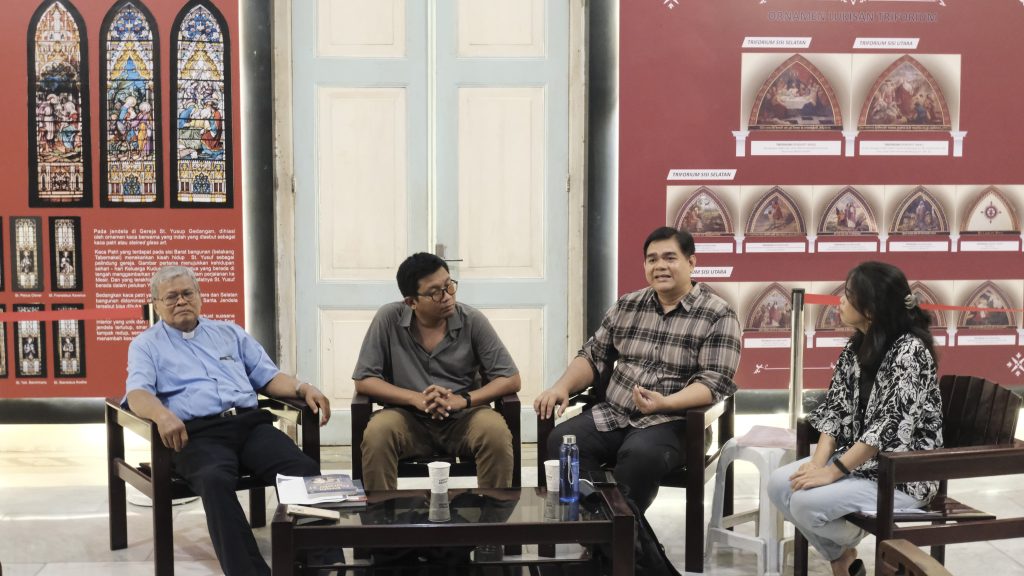
Hi, I’m Lusia, though most of my friends call me Aisul. I am a member of the OMK (Catholic Youth Organization) of Gedangan Parish. I love traveling and history, especially when listening to stories about the past. Now, I want to share about Gedangan Church, the oldest Catholic church in Semarang. The OMK here has an exciting platform to get to know our church more deeply, called Jelajah Gedangan (exploring the Church of Gedangan). The purpose of this activity is to reintroduce the Church of Saint Joseph in Gedangan, particularly from a historical and faith point of view. The tour guides are also from us, the OMK Gedangan, where we gather, discuss, and uncover old stories about this church, and share them with those who are interested.   We started Jelajah Gedangan at the end of 2019 until early 2020, even though the Covid-19 pandemic had just begun. We took the initiative to replace the activity with virtual Jelajah Gedangan, which allowed us to reach people who wanted to know more about Gedangan. During that time, we shared stories about Gedangan’s history, the figures who had been part of Gedangan, and the ornaments typically seen during mass. The themes we discussed became increasingly diverse over time.     In 2025, Gedangan Church will celebrate the 150th anniversary of the consecration of its church building. A series of events will be held throughout the year, one of which is the Mini Talk Show Jelajah Gedangan, which took place last June. At this event, participants, who were usually taken on a tour of Gedangan, were able to sit down and listen to stories from several speakers related to Gedangan Church.   Three speakers participated in the talk show. First, Fr. Vincentius Suryatma Suryawiyata, S.J., shared fascinating stories about the figures who shaped Gedangan Church and emphasized the importance of the missionary spirit that originated here. In addition to Fr. Suryatma, there was also Fr. Ignatius Windar Santoso, S.J., who showed documentation of previous baptism records. From these records, we learned that Semarang was an important place in the history of Catholicism during the Dutch East Indies period, and Gedangan played a role as the first gateway for Catholic missions in Java.   Another narrative was shared by Mas Yogi, a historical observer. He shared surprising facts about Gedangan Church archives and his experience guiding Dutch people seeking to learn about their ancestors’ history. It turned out that one of their ancestors was a famous artist from the past. They also brought photos to compare the church as it was then and as it is now.   From the stories of the interviewees, I realized how important archives such as baptism records are in bridging generations. These records are not only historical evidence but also help people find their families and connect their life stories. The Jelajah Gedangan Mini Talk Show was a true meaningful experience, with each speaker bringing their own unique stories.   I am grateful to have been a tour guide at Jelajah Gedangan and to have participated in this 150th anniversary. We will continue to share and learn about history while reviving stories that are nearly forgotten. In November this year, we will organize the second Jelajah Gedangan Mini Talk Show with new stories and perspectives. Don’t forget to follow Instagram @gerejagedangan and @gedanganmuda for the latest updates!   See you around in Gedangan.     Contributor: Lusia Pamungkas – Gedangan Muda
English

Societal Service of Pingit Village: An Account to Remember

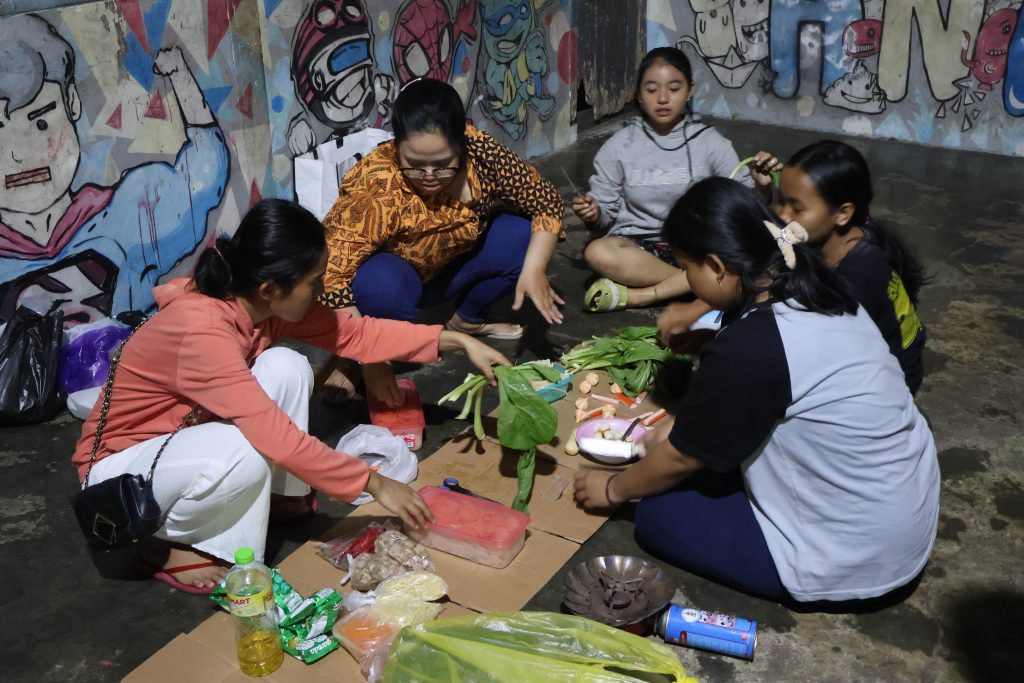
On Monday afternoon, I felt anxious about the rather worrying cloudy weather. Rain is considered romantic by some people, but for me, who uses public transportation or online motorcycle taxis, rain is a challenge. I, along with the other volunteers, had scheduled a cooking session with the children at the Pingit Social Settlement (PSP) Yogyakarta, with seblak (made of noodles and crisp) as the main dish. Despite concerns about a shortage of cooking equipment and ingredients, we prayed that everything would go smoothly.   Upon arriving at the location, the children were very enthusiastic about participating in the cooking class. The class was held in the community hall for comfort. The children began with a short, heartfelt prayer, and the class went on longer than scheduled, with even children from other classes joining in. The volunteers teaching the class aimed to provide material different from the academic curriculum at school. Our material emphasized values such as “Survive and Sustain.” They hope this material will become a cherished memory for the children when they grow up.   Before the cooking session, the children were allowed to get creative decorating cakes, in the hope that some of them might become chefs or food entrepreneurs in the future. In class, they were also introduced to maps of Southeast Asian countries to broaden their knowledge and learn about life outside their region.   While cooking, there was a shortage of seasoning, and a young girl offered to buy the seasoning using her own money. Although the author felt touched and wanted to refuse her offer, the child insisted and ran to buy the seasoning. This brave and sincere act from the young child moved the author, reminding them that as we grow older, we often lose the qualities and spirit of childhood.   That evening’s cooking class offered many valuable lessons, and the author realized the importance of maintaining enthusiasm and generosity even as we grow up. With gratitude, the author concluded this experience, hoping that children can learn and find meaning in every process they go through.     Contributor: Theresia N.L, – Volunteer Pingit 2025

English

IAJU Assembly 2025: Rewriting new chapters of Jesuit Higher Education

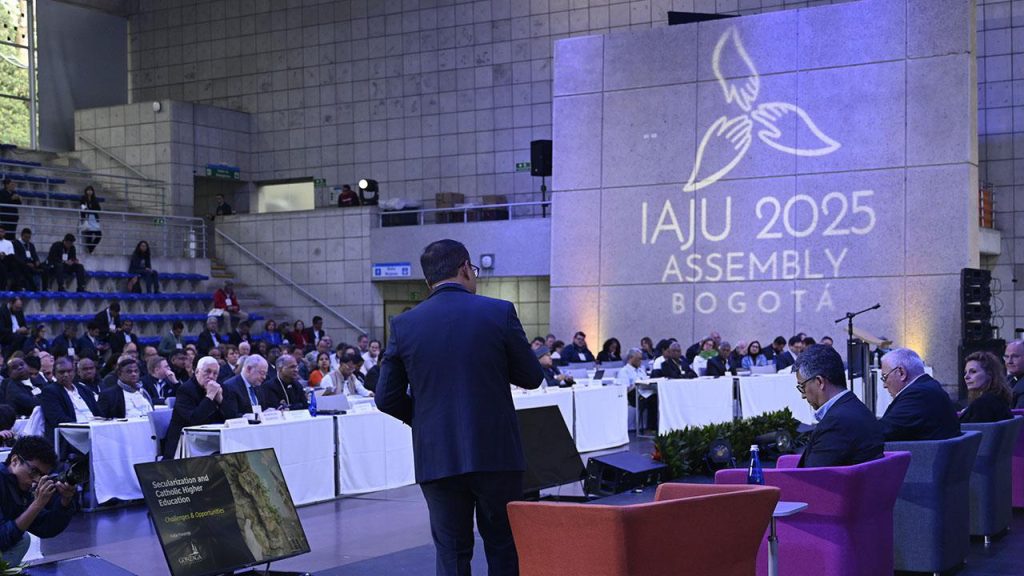
The International Association of Jesuit Universities (IAJU) Assembly 2025 took place from June 30 to July 3, 2025, at Pontificia Universidad Javeriana in Bogotá, Colombia. This important three-yearly meeting involved 170 Jesuit universities from around the world, including Universitas Sanata Dharma (USD). The assembly aimed to develop joint strategies to address global challenges in higher education. The theme was “Our Mission in Challenging Times: Let’s Write the Next Chapter of Jesuit’s Higher Education History,” and it began with an inspiring speech by Father General Arturo Sosa SJ, who emphasized the need for Jesuit universities to be creative and dialogic, rooted in Ignatian identity. He outlined three main pillars for Jesuit higher education: Charism, Context, and Way.    Over 300 participants attended the assembly, including the USD delegation led by the Rector Fr. Albertus Bagus Laksana, S.J. and Vice Rector for Cooperation Caecilia Tutyandari. USD expressed its commitment to strengthening the global network of Jesuit higher education, focusing on transformative, contextual, and socially impactful education.    One significant session addressed the challenges of secularism in Catholic higher education, with Rector Pater Bagus serving as a panelist. He discussed how secularism appears in different forms and contexts, highlighting the strategic role of Catholic universities in confronting these challenges. Msgr. Carlo Maria Polvani encouraged participants to study secularism’s symptoms and challenges specific to their context and how religion interacts with secularization.   Pater Bagus explained the unique dynamics of secularization in Indonesia. In urban youth, there is a tendency to distance themselves from religious institutions while still seeking spiritual meaning. Religious identity is becoming more fluid, open, and often hybrid, reflecting a plural culture and global challenges. He stated that the main challenge is not repression of the Catholic faith but the weakening of Catholic values in public life due to market forces and competitive education systems.   He proposed a framework of human flourishing that creatively unites religious, ethical, and social aspects. USD has integrated this framework into its academic mission, collaborating with institutions like the Australian Catholic University and Universitas Gadjah Mada. Recently, an international conference on this topic was held in Rome, featuring researchers and delegates from various institutions.   Pater Bagus highlighted the vital role of Jesuit universities in creating spaces for intercultural and interfaith dialogue, supporting students in their search for meaning, and fostering public leadership based on justice and compassion. In this context, secularization is not seen as a threat but as an opportunity to renew faith and spirituality authentically.   During the four-day assembly, various other topics were discussed, including the impact of artificial intelligence on learning, environmental justice, student mental well-being through Ignatian spirituality, immigration, refugee issues, and the complexities of democracy and identity. USD’s participation reaffirmed its commitment to holistic, transformative education, contributing to global solutions, and fostering solidarity with Jesuit universities worldwide.     The assembly aims to strengthen a shared vision for Jesuit higher education globally, develop concrete strategies to confront contemporary challenges, and expand collaboration networks across education and research. This event further establishes USD as a leading Jesuit university in Southeast Asia, contributing to building a more just, sustainable, and hopeful world.     Contributor: Antonius Febri Harsanto – Humas Universitas Sanata Dharma

English

Nasi Berkah, A Blessing to Others

On June 8, 2025, the Community of Hermanum College gathered with donors to review and reflect on the “nasi berkah” (blessed rice) program, which provided rich learning experiences for the participants from October 2024 to June 2025. This program continues to serve those impacted by economic hardship, expanding from its original location at the Scholasticate of Pulo Nangka to other scholasticates like Kampung Ambon, Johar Baru, Kramat 6, and Kramat 7 (Wisma Dewanto). Each unit distributes 30 food coupons per week, each worth a subsidy of Rp10,000, while recipients contribute Rp2,000 to partner food stalls.     The program faced challenges, including staff changes that affected coordination, price increases from food stalls due to rising ingredient costs, and miscommunication regarding payment systems, especially when main coordinators were absent. Additionally, irregularity in coupon distribution occurred due to the academic and internal commitments of participants.     A key strength of the program lies in the personal relationships formed. Many participants shared how the coupons provided access to food and meaningful connections. Recipients eagerly awaited their weekly distributions, and food stall owners also felt engaged, some even adding extra food to show their support. Active partners and donors, such as the families of Ibu Fifi and Ibu Khim, view providing decent food as a way to value community and see the initiative as more than an economic transaction but also an opportunity to share kindness consistently.     The program reflects a responsive approach to Universal Apostolic Preferences, particularly in standing with marginalized individuals, emphasizing that no one is alone. Participants, especially expatriates, find this initiative a chance to learn about Indonesian language and culture while engaging with social realities. Despite practical challenges, small moments serve as lessons in deepening love through tangible actions.     Moving forward, decisions were made to improve the program’s effectiveness, such as adjusting coupon prices to match economic needs, enhancing payment transparency with receipts, prioritizing communication with partner stalls, and focusing on the genuine needs of recipients rather than their social status. The aim is to foster collective care and touch many lives—recipients, stall owners, participants, and donors alike. The program encourages consistent, meaningful sharing, posing the question of how individuals can be channels of grace in simple yet significant ways.     Contributor: Sch. Laurensius Herdian Pambudi, S.J.

English

Becoming Companions through the Path of Hope

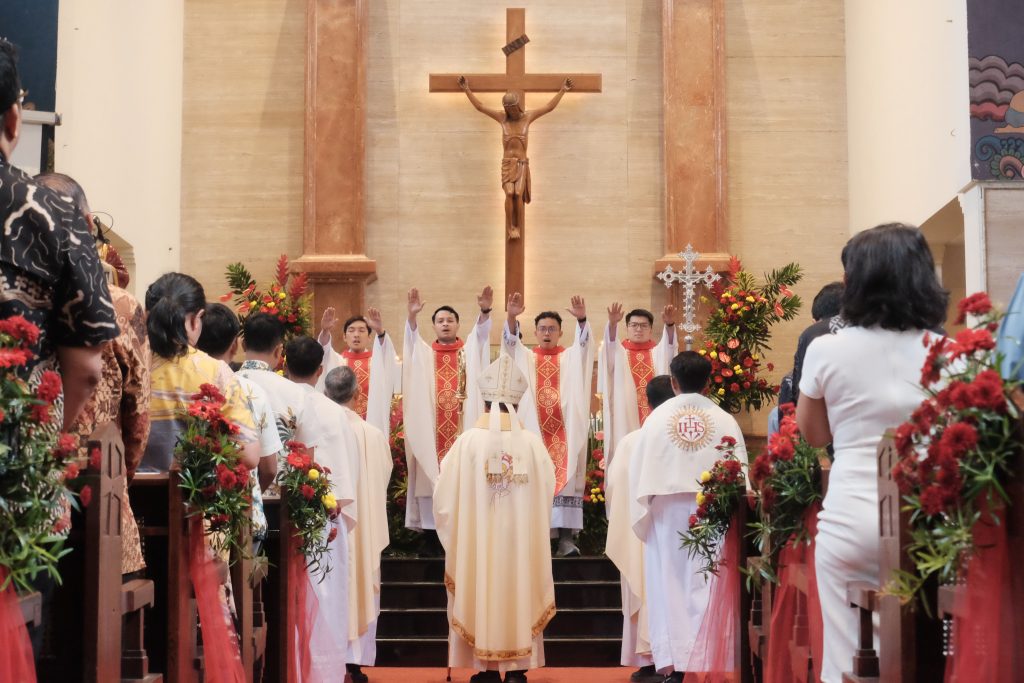
Four deacons of the Society of Jesus, SS Antonius Septian Marhenanto, Isodorus Bangkit Susetyo Adi Nugroho, Jacobus Aditya Christie Manggala, and Leo Perkasa Tanjung, were ordained to the priesthood by Archbishop of Semarang, Mgr. Robertus Rubiyatmoko, at the Church of St. Anthony of Padua in Yogyakarta on July 23, 2025. Families, guests, and many other faithful joined the solemn ordination Mass with great gratitude.   In his homily, Archbishop Rubiyatmoko emphasized the importance of commitment and deep determination for the newly ordained priests. He reminded them that the Sacrament of Holy Orders should be understood as a celebration of gratitude for God’s grace. This year’s ordination theme was “Becoming Companions on the Path of Hope,” which underscored the role of priests as companions to Jesus and the marginalized and wounded. Priests today must be more than just teachers; they need to be present, listen, and heal the wounded.   Archbishop Rubiyatmoko advised priests not to lose hope, as hope brings effort and results. They are not alone in this task, as God and their fellow members of the Society of Jesus are ready to support them. At the end of his homily, he expressed the hope that the new priests would become true friends to those in need and bring them hope. Additionally, they were reminded to follow the example of Saint Paul in finding joy even amid suffering.   After being ordained, the four new priests were assigned their respective duties: Fr. Antonius Septian Marhenanto will serve as the Full Time Coordinator of the IDO Province Communication Team, Fr. Isodorus Bangkit Susetyo Adi Nugroho as a staff member of YPPK Adhi Luhur High School in Papua, Fr. Jacobus Aditya Christie Manggala as Director of Campus Ministry at Sanata Dharma University, and Fr. Leo Perkasa Tanjung will further his studies in Sacred Scriptures in Rome. They gave their first blessing to the congregation after the Mass, followed by a reception at St. Ignatius College. It is hoped that they will shepherd the faithful with love and care.   Contributor: Bonifasia Amanda – Indonesian Jesuit Communicator Team

English

Seeing Overseas Refugees in a New Light

World Refugee Day, celebrated on June 20, aims to raise awareness about the conditions of refugees and appreciate their resilience in the face of conflict and persecution. On June 21, 2025, a bazaar themed “A month of stories and solidarity” was held at M-Bloc Space, Jakarta, as part of this commemoration. The event involved many organizations, including UNHCR, Refuture, SUAKA, and JRS Indonesia. As a staff member of JRS Indonesia, I attended this event for the first time and was very excited. My task was to receive guests and record visitors, as well as explain the activities related to World Refugee Day. I worked together with Diana from SUAKA and Rahma from CWS to encourage people to learn more about refugees. The event involved many parties. They supported multimedia, sound systems, MC, and other equipment. Many refugees arrived early to set up booths selling specialty foods and crafts from their home countries, such as Afghanistan, Pakistan, Palestine, Somalia, and Rohingya Myanmar. This activity helped to increase the understanding of refugees and their situation among people in Jakarta.   As a social worker, I understand that refugees, both as individuals or groups, are forced to flee their home country due to conflict or persecution. Until now, Indonesia has not ratified the 1951 Convention on the Status of Refugees, which makes it difficult for them to work and make ends meet. They rely heavily on the assistance of international organizations.   World Refugee Day provides hope and an opportunity to get to know refugees from better perspectives. I am inspired by Pope Francis’ message that calls us to care for marginalized people and support them. I hope that this event can raise public awareness to care more about refugees who face an uncertain future.   Contributor: Adi Priyanto – JRS Indonesia

English

Shared Vision, Different Approaches

Surakarta Palace and de Britto High School: A few days ago, on May 17, 2025, my classmates and I visited the Palace of Surakarta as part of our P5 (Project for Strengthening Pancasila Students’ Profile). Our goal was to learn about the Surakarta Palace from the palace’s point of view. The journey took about an hour, and the roads were pleasant to travel on. Although I didn’t sit by the window, this allowed me to socialize with my friends, making the trip enjoyable. After some time observing the surroundings, we arrived at the Palace of Surakarta. We entered through the main gate, a large entrance for vehicles. The palace has seven unique sections, and we had just passed through the first gate. Each gate has its philosophy, starting with the first gate called Nggladhak, symbolizing a person’s birth into the world. It features two statues of Gupala, representing acceptance of one’s fate. This gate is also used for animal sacrifices during certain ceremonies. Moving deeper into the palace, we encountered two pairs of banyan trees. Here, the philosophy represents a man’s authority and a woman’s grace, symbolizing the existence of two genders in the world. Further along, we arrived at Kori Wijil, a place signifying the journey to adulthood, indicating that one should know their purpose and position in life. Across from Kori Wijil, we passed Kori Mangu, where a large mirror was displayed for self-reflection. It serves to assess whether we are ready in terms of appearance, attitude, and heart to enter the deeper areas of the palace. Next, we passed Braja Nala, which means Inner Weapons, suggesting that one should sharpen the spirit to become closer to the Creator. This area has two buildings: Marchu Kunda (where rule breakers are punished) and Kedhaton (for promotions of loyal servants). Even though Kedhaton is a place for honours, we were welcomed to rest there. We proceeded to Kori Kemandhungan, which prompted more introspection about our readiness to enter the palace. After Kori Kemandhungan, we reached a place named Sri Manganti, marked by a large blue gate. If someone wishes to meet the king, they must wait at this point until a royal messenger calls them. This gate symbolizes paradise, meaning that after living through various experiences, we ultimately return to our father’s (God’s) house.   While there are many more places in the palace I could describe, our visit included these significant locations. This experience allowed me to appreciate the rich cultural values embedded within the palace, which interestingly align with the Ignatian-Jesuit spirituality of Kolese de Britto High School. The blue colour of the palace buildings represents divinity, akin to the blue sky signifying greatness. Surakarta Palace acknowledges God and seeks guidance in life, similar to de Britto’s spirit of Ad Maiorem Dei Gloriam, living for the greater glory of God.   This suggests that both de Britto and Surakarta Palace share a common spirituality regarding hope in God, despite using different languages. Another interesting spiritual aspect is the two large mirrors in the palace. These mirrors prompt us to reflect on whether we are ready to enter the palace. The mirrored moments of self-reflection are akin to the Examen, which encourages us to evaluate our actions and opportunities for improvement on daily basis. Reflection is crucial for recognizing what needs to change, enhancing our commitment to personal growth. We should plan activities, but realize that without execution, there cannot be results or meaningful outcomes. Therefore, interpretation and deep understanding are vital to inspire action on our plans. Like the Examen, which is advised to be practiced twice a day, this indicates a shared spirituality between the Palace and de Britto, focusing on meaningful self-improvement through thorough reflection. This illustrates that achieving a common goal can be accomplished through various paths. The different expressions of spirituality in Kolese de Britto High School and Surakarta Palace both lead to the same ultimate purpose. This was the essence of our P5 experience that day and the foundation of this reflection piece. This perspective extends beyond the discussed spirituality to our views on various matters, particularly religion and belief systems. Recognizing that different beliefs do not necessarily imply negativity is essential. Numerous religions are teaching the importance of faith in God, doing good, and avoiding evil. Although differing belief systems exist, we should refrain from judging others’ faith, as everyone’s relationship with God is personal. Similarly, regarding our approach to learning and understanding nature, we might encounter various challenges. However, every approach serves the singular goal of development. There are many ways to learn, whether through reading, listening to teachers, or practicing problem-solving. If the objective is to enhance learning and understanding, the outcomes will align with those aims.   Contributor: Dionisius Adven Pramana – Siswa SMA Kolese de Britto

English

Four Stages Towards Global Collaboration among Jesuit Alumni

WUJA PRE-CONGRESS PREPARATIONS: Jakarta, May 4, 2026 – The preparatory committee of the World Union Jesuit Alumni (WUJA) Congress held another coordination meeting to strengthen strategic steps ahead of the pre-congress implementation. The meeting was chaired by Mr. Elman and attended by the Steering Committee (SC) and Organizing Committee (OC). This meeting emphasized that the WUJA pre-congress activities are not just an introductory agenda, but an important space to filter ideas, build a collective identity of Jesuit alumni, and design real collaborations across regions and generations.   Four Stages of Pre-Congress During the meeting, it was agreed that the pre-congress would be divided into four main stages: Mapping Ideas and Figures The first stage aims to narrow down the main topics and attract competent speakers from the alumni community. This forum is a space to explore ideas that will be brought to the main congress. Expected outcome: strategic discussion points. Drafting an Identity Manifesto The focus of the second phase is on fundamental questions: Who are we as Jesuit alumni? It is hoped that a manifesto of shared identity will emerge as the basis for a sustainable alumni movement and engagement. Designing a Governance Framework The third stage touches on the implementation aspects: how to form a working structure, roles, and governance that involves various stakeholders, from Jesuit schools, alumni, to supporting organizations. The final result is a collaborative manual. Real Collaboration Model The fourth stage became a moment of concretization of ideas through the design of a collaboration model between alumni and institutions. This is a tangible form of the spirit of partners in mission. The focus is on collaborative actions that can be widely adopted and sustainable. Target Time and Communication Strategy George, chair of the SC, emphasized that although the initial estimate was quite tight, there is currently time until the end of the first quarter of 2026 to complete the entire pre-congress series. This gives room for deepening the material and wider engagement. Meanwhile, in terms of communication, it is proposed to develop narratives of alumni figures from various communities as internal publication content. This is intended to strengthen the sense of belonging and active involvement of alumni communities around the world. The Role of Schools and Alumni In the discussion, there was also a critical reflection on the importance of introducing the spirit of Jesuit alumni from school days, not after graduation. Jesuit education needs to nurture relationships with its alumni early and continuously. “Alumni are not only products of the school but also partners in mission. So, the relationship must be designed from the beginning,” said Adhi Anondo in the reflection session. Global Collaboration and Strategic Plan One of the highlights of the discussion was the idea to develop a strategic plan for the next four years post-congress. This plan reflects the continuity of alumni commitment in responding to various local and global issues through a contextual and adaptive Jesuit spirit. Thus, the WUJA pre-congress is not only a momentum of reflection, but also the beginning of a more structured, collaborative, and impactful Jesuit alumni movement.   Contributor: Markus Budiraharjo – IASM/Ikatan Alumni Seminari Mertoyudan